Stop Waiting for the Storm to Pass: Running a Business in Uncertain Times
I asked a half dozen fellow business owners the same question this week: “So what are you doing about it?” Every one of them gave me the same answer. “I’m waiting for the storm to pass.” I understand the instinct. But I’ve lived through that answer once already, and it cost me years.
So this week’s episode is about running a business in uncertain times, what the numbers actually say, and why the worst move you can make right now is to put your business in neutral.
The Storm Is Here
Six months ago you could still argue about whether the storm was coming. Not anymore. On September 11, diesel crossed $6.06 a gallon nationally, the highest it has ever been.
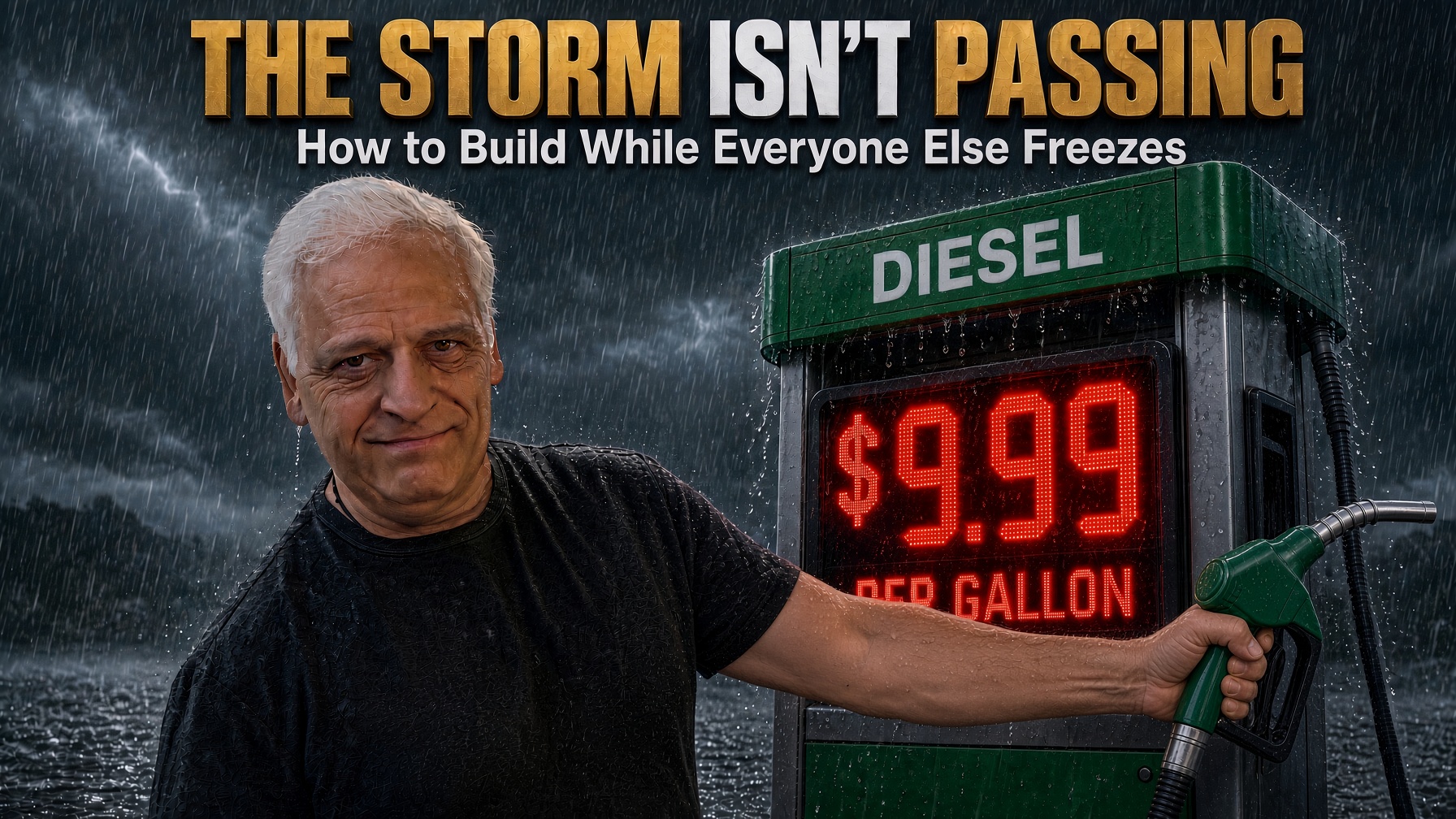
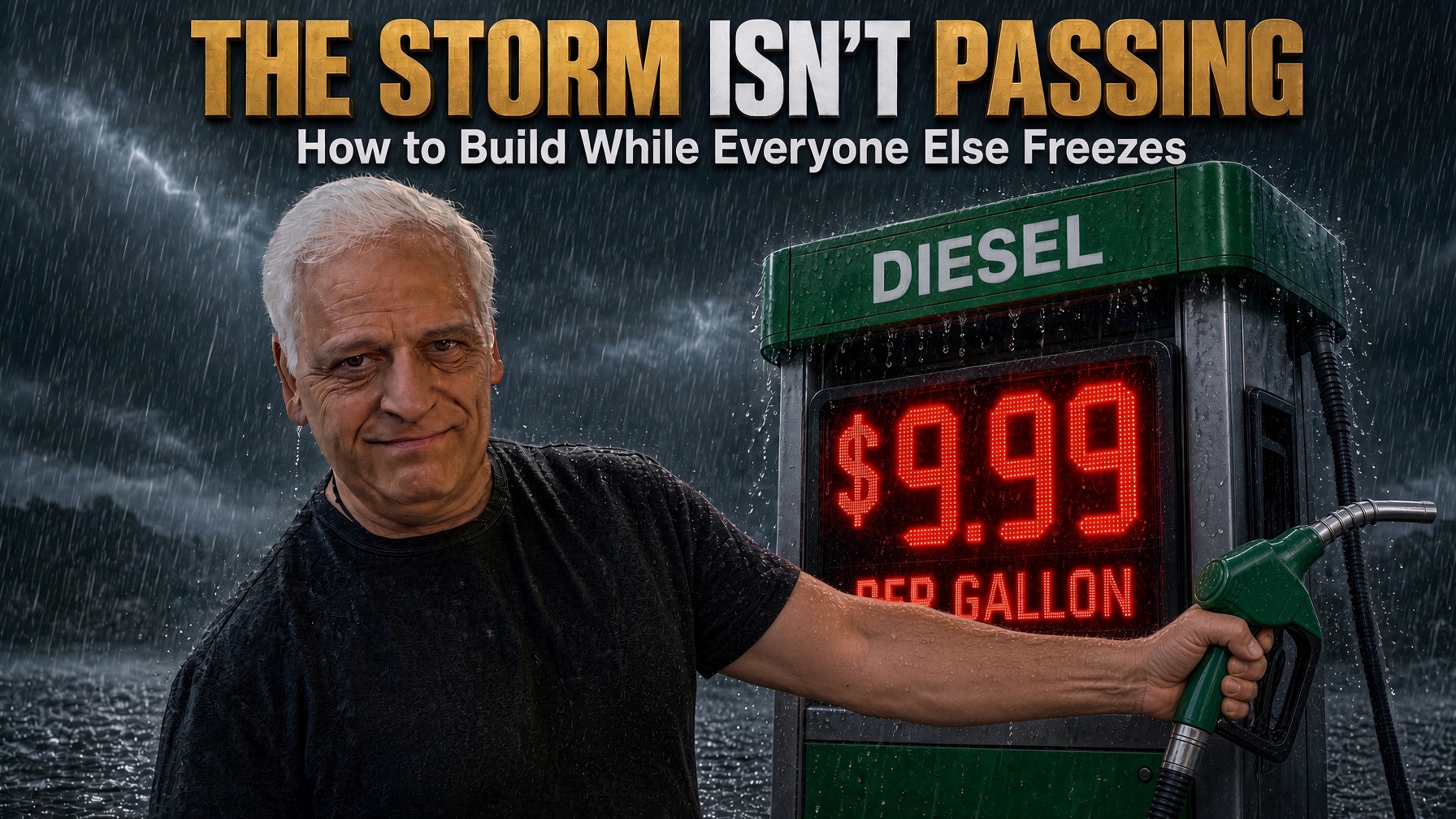
California diesel was already at $7.98. And here in San Diego, I put a slide up on the show with a number in green that made the chat room gasp: $9.99 a gallon for diesel, $9.39 for premium gas. That happened in Los Angeles last week, and now it’s here. Not every station, but the edge of the market is at the ceiling.
I mean that literally. A gas pump only has three digits. It can’t display $10.01. So I told my friend Bruce on his show earlier this week what I expect to happen next: stations will drop the posted price to something like $5.50 and quietly change the unit of sale to a half gallon.
Sound crazy? When gas hit $3.99 in 2005, some states allowed exactly that. Pumps showed half-gallon pricing with mandatory signs telling customers to double the number. It’s been done before.
Why is this happening? The story now is that Ukraine is bombing Russian refineries, taking supply off a global market where demand hasn’t budged. Prices aren’t local. They’re set on the futures markets, and when supply drops everywhere, the price rises everywhere. Canada is paying $1.92 a liter, which works out to about $8 a gallon. This is not a one-week news cycle.
Why Prices Go Up Fast and Come Down Slow
Here’s the part that matters for your business. Nothing in your house arrived without a truck or a boat, and those run on diesel. When diesel spikes, the cost of everything underneath it spikes too. Economists are already on record saying the damage will linger even if the fighting stopped tomorrow, and I believe them, because I watched it happen in 2007 and 2008.
Gas spiked, UPS added a fuel surcharge to every package, and that surcharge never went away. Even when gas fell below where it had started, the surcharge stayed. We call it sticky pricing. A supply threat shows up and prices are higher the next morning. The threat disappears and it takes months for prices to settle.
Layer the rest of the picture on top of that. The Consumer Price Index hit 3.3% in March, the highest since May of 2024, driven by energy, and that was before this latest spike. The Fed wants 2%. Instead of cutting, they just raised rates another quarter point, which means your variable-rate credit cards got more expensive this week. GDP growth for 2026 has been cut to roughly 1.8% from 2.1%, and that gap is trillions of dollars of commerce that isn’t going to happen. This is a slow bleed, not a headline.
What the Small Business Numbers Say
I pay close attention to the small business community because that’s who I’ve been training for thirty years. The NFIB data says 80% of small business owners report energy costs are having a significant impact on operations right now. When costs rise, an owner has exactly two moves. You can eat the increase and cut your own profit, which 58% are doing.
Or you can raise prices, which 52% are doing. Plenty are doing both, because the numbers are moving too fast to absorb.
Neither move is painless. You can eat costs for a little while to protect the business, but do it too long and there’s no money left to fix what breaks. Raise prices and you chase customers away. Think about your cable bill going up ten dollars. It’s only ten dollars, but it’s $120 a year, and it’s the same service you had last week. A lot of people cancel.
The statistic that stopped me cold was this one: only 8% of small businesses have avoided cost increases entirely. That’s not a story about clever operators who dodged it. It means 92% of the businesses in this country are carrying higher costs today than they were a few months ago, and most of them are struggling to keep the doors open.
I’ll be honest about my own numbers too. I’ve been working hard to bring people into my coaching programs, and it’s been crickets. In thirty years I’ve never had a stretch like it. There was always someone in my inbox with a question about marketing or selling online, and I could get most of them on the phone and into a program. Right now the people are frozen.
They’re on the sidelines, and not just in this country. When my wife heard the 8% figure she said, “Don’t beat yourself up. This explains it.” She’s right. But explaining it and accepting it are two different things.
Lower Gear, Not Neutral
This is the lesson I paid for in 2008. Taxes went up, the health care mandates hit, and I watched clients in the seminar and promotion business shut down because they couldn’t carry the load. So I slowed down too. I decided I wasn’t going to do anything until things settled. And I lost momentum I had spent years building.
My customers saw me go quiet and didn’t know what to do. When the economy came back around 2012, I was so far behind that catching up took years. The game had moved two stops ahead of me.
So here’s my rule for running a business in uncertain times: take a couple of days to get your bearings. That’s normal. But when a couple of days becomes a couple of weeks, and then a couple of months, you’re in trouble. Slow down if you have to. Put it in a lower gear. Never put it in neutral.
That applies to your plans as much as your business. The “someday syndrome” is one of the biggest things I see in the people I coach. This may not be the right time to build the new house, buy the new car, or start the renovation. It is exactly the right time to plan them. We’ve got twenty acres here and a building we want to put up for a studio and live events.
We don’t know when. But we walk the property and talk about where it goes, and when things turn around, and they always do, we’ll be ready while everyone else is just starting to think.
Take Care of the Person Running the Business
Some of this is practical. Limit your exposure to the news. Check in for ten or fifteen minutes, and if nothing is breaking, get back to your life. Every headline is designed to grab your attention, and you don’t have to give it.
Keep your routine. When COVID shut everything down, my advice to clients was to get up at the same time, have your coffee at the same time, and run your day the way you always did as much as you could.
That’s how you keep the disruption from becoming trauma. And find a different way instead of stopping. We haven’t been eating out because lunch for two is over seventy dollars now. So we buy the salmon and the greens at the farmer’s market and make it at home. Cheaper, healthier, and we still get lunch.
Some of it is emotional. I spoke with a woman this week who was very afraid, and when I listened for what she wasn’t saying, it was the unknown. I asked her: if you had extra water, some canned goods, a few things put away, would you still feel that fear?
She said no, she’d feel prepared. That’s the whole answer. There is no downside to being prepared, and the upside is that it moves you from fear to strength. Anchor yourself in what you have right now, a roof, food in the fridge, people around you, and radiate out from there.
And don’t do this alone. Talk to your peers. Tell them you think Robert might be full of it and let them argue with you. Get it out instead of bottling it up. If the people watching the show want a Zoom call to talk through what’s happening, I’ll build it and facilitate it.
Choose Your Response
We don’t get to choose what happens out there. We do get to choose how we respond. Fear isn’t something you can buy by the pound. It’s how you’re representing what’s going on inside your own head.
I’ve chosen excitement, because I believe this is the required step to get us to the other side, and my picture of that other side is strong enough to focus on. Every generation gets its challenge. This one is ours. Stay in the game, stay in motion, and be ready when the weather turns.
Download This FREE Library AI Prompts that can save you 10 or more hours per week!
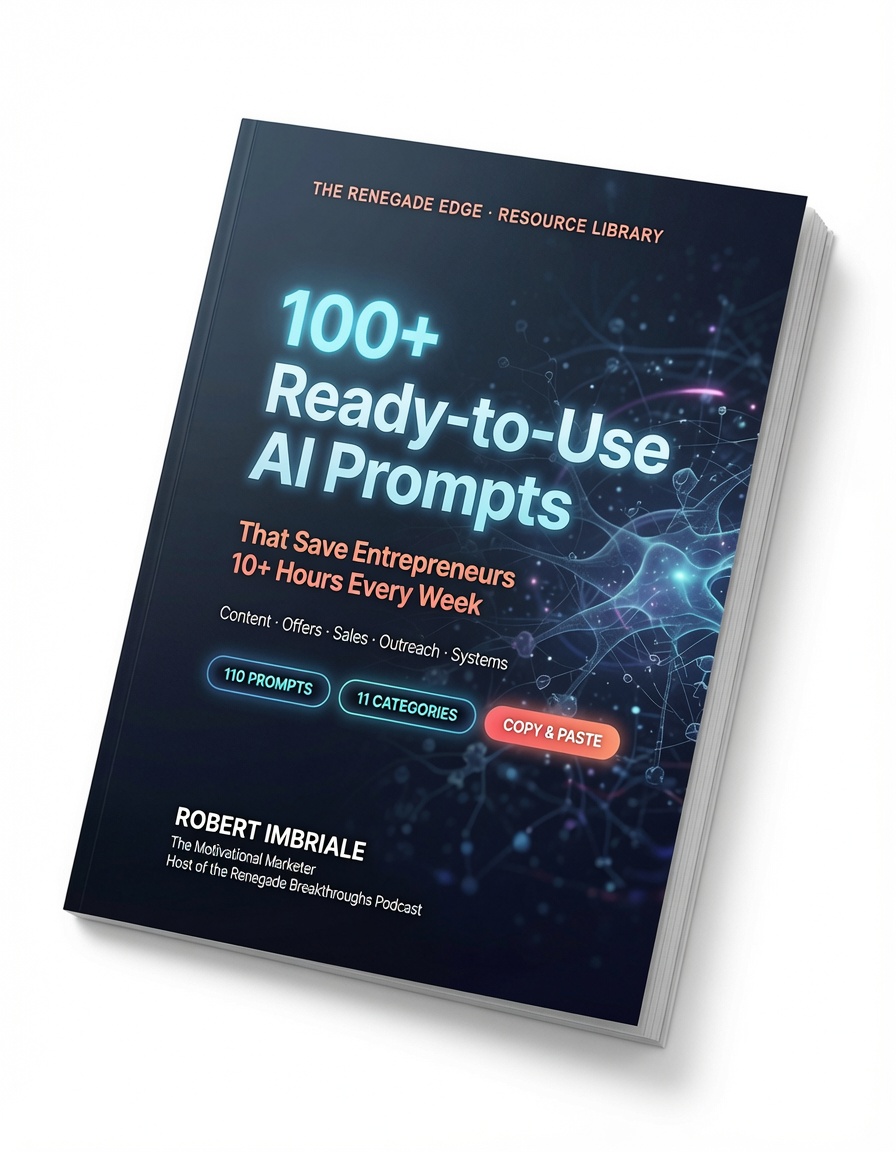
This is for you if you’re an entrepreneur, coach, consultant, or creator who:
– Wears too many hats and never has enough hours in the day
– Knows AI *should* be saving you time but hasn’t cracked how
– Would rather spend your energy on the work only you can do – not on writing every email, caption, and offer from scratch
If that’s you, this library was built for exactly where you are right now!
Free instant access. No credit card, no catch.
The post Stop Waiting for the Storm to Pass: Running a Business in Uncertain Times appeared first on Robert Imbriale.